

2.3.4 - Platform Master Plan
🧠 Mental Model › 🌌 Linear to Non-linear Innovation


When Linear Plans End Up As Dead Ends
For many companies and teams, there is a justifiable, but overwhelming pressure to make timely and effective decisions. So much so, that the siren song of certainty, even the perception of it, offers a sense of control over an obscure, unknown future. It can quell anxieties among stakeholders, justify significant investments, and provide a seemingly solid foundation for “strategic planning”. Organizations spare no expense and effort to obtain it, even if it is completely contrived or entirely questionable. If the previous misconceptions are to be believed, then it points to a persistent incompatibility between how platforms naturally function and how corporations try to manipulate them to behave.
While prior issues mainly dealt with the intrinsic properties of platforms that were critical to informing the design and direction for how and where to start, the current misunderstanding has more to do with the extrinsic factors that implicates all of the surrounding operational work that supports in-progress activities. Despite avidly pursuing rapid expansion and growth, the dependence on detailed plans results in marching orders that do not easily lend itself to improvisation and on-the-fly adjustments. In practice, this obsession over predictability and precision has the opposite effect—sterilizing the raw, unfiltered elements within the organization from otherwise adding the je ne sais quoi that elevates a platform to new heights.
No plan survives contact with the enemy.
— Helmuth von Moltke
The consequences of this perspective manifests into crushing ceremony, oppressive overhead, and prescriptive procedures that have reduced companies to a set of sequential, step-wise rites and rituals offered to the cargo cults who certify that they are SAFe® from harm. Team leads will submit to the liturgy of the daily standup, iteration planning, backlog refinement, scrum of scrums, and others in adherence to “estimates” and timetables visualized by the customary Gantt chart. Managers will sweat over due dates and obsess over burn down charts as they try to anticipate the coming of the great platform messiah. But the funny thing is that predictions frequently miss the mark. And as a result of such narrow, sequential plans, teams are led to believe they have reached a dead end when things do not go according to expectations. This process somehow worked for products since there is a modicum of control that allowed for a linear model to eke out a bit of success, but platforms are not so forgiving.
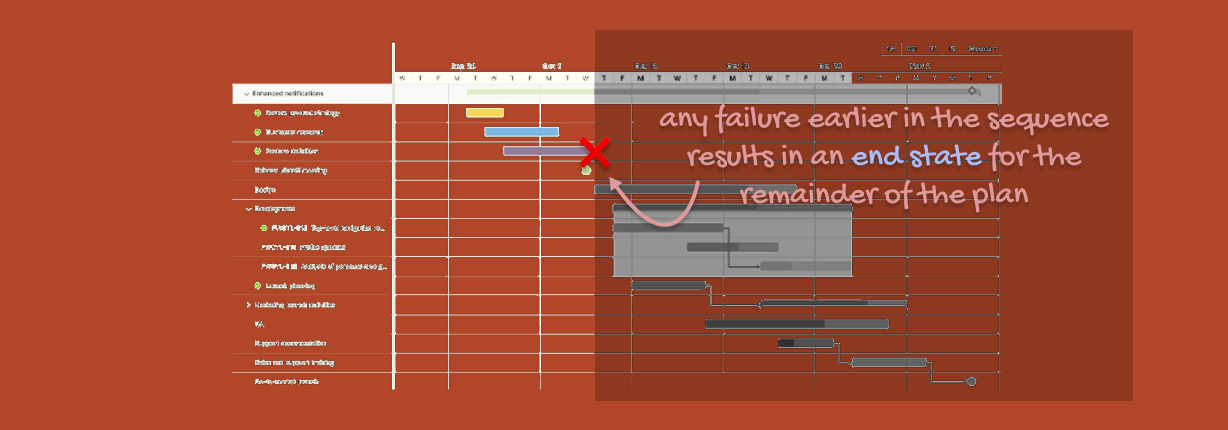
Stuck in a Pseudo-linear Loop
In preparing for battle I have always found that plans are useless, but planning is indispensable.
— Dwight D. Eisenhower
This is not meant to say that platforms are completely random and planning is useless, but to point out that the present state of affairs severely limits our capacity to handle volatility and account for outliers. Humanity is hardwired to favor controlled, predictable environments (even illusory ones) over extreme and chaotic ones. Therefore, it is more instinctual to cling to a familiar linear operating model than to convert to an unnatural non-linear one, an inclination that is especially pronounced within the corporate modus operandi.
For all the fanfare that accompanied the years of proselytizing the virtues of agile development, failing fast, and non-linear design, very little has been accomplished to substantively transform the way the industry works overall—kitschy graphic tees and swag notwithstanding. There is an unassuming, but regressive orbit that reverts companies back to superimposing a fixed linear filter over a fluid non-linear pattern. For example, take the ideas behind the design squiggle or the double diamond. While, initially, they appear to manage uncertainty and variability, closer inspection shows this impression gives way to just another single path from point to point: a clear depiction of linear cause-and-effect.
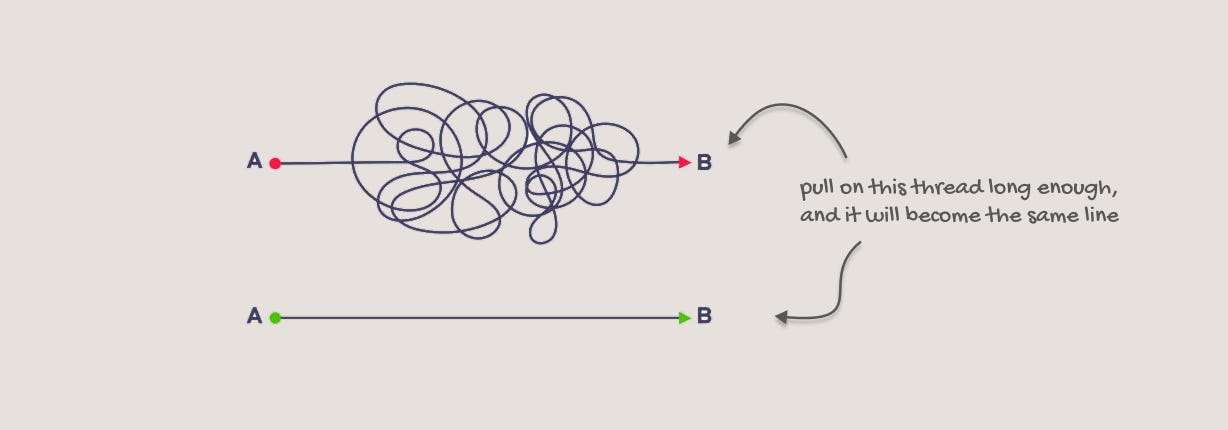
These approaches undoubtedly preach a process much more sophisticated than what what meets the eye, but this spark of misinterpretation is all it takes to burn the whole house down. Subtle distortions like this one are compounded on top of each other and then codified into the everyday management tools and software that cause teams and organizations to view the burning brimstone around them as just "business as usual". They convince themselves that their shortcomings are merely "iteration cycles" around the curvy, winding path of a platform master plan, believing that they are moving beyond linear thinking just because they are perpetually rounding a bend. But curves are simply straight lines that curl while true non-linearity breaks, jumps, mutates, splinters, and flares into multiple unforeseen off-shoots. The greatest resistance to change comes from the teams, leaders, and companies who perceive that they already are doing so, but are really stuck in a circular loop, unwilling to challenge the fictions they have conveniently weaved to justify their shortcomings.
Sometimes people don't want to hear the truth, because they don't want their illusions destroyed.
— Friedrich Nietzsche
Overflowing With Non-Linear Options
Platforms are not static. We call them platform dynamics for a reason:
#3 Platforms do not follow a singular, discrete path. Platforms spread into multiple simultaneous, non-deterministic trajectories.
If we are serious about harnessing and capitalizing on the volatile energy of platforms (and beyond), we need to stop being singularly fixated only on overhauling the technology, and focus also on dismantling the operational barriers and biases that starve platforms of the necessary conditions to thrive in the first place. If we cannot transcend our basic natures, progress will remain purely as fancy rhetoric. This is made more difficult due to the limitations of existing operating models and their linear portrayals. We will continue to wander lost in the wilderness unless we obtain a proper mechanism that can map all of the points of interest, breakpoints, thresholds, and branches that better depicts the non-linear dynamics of platforms and more.
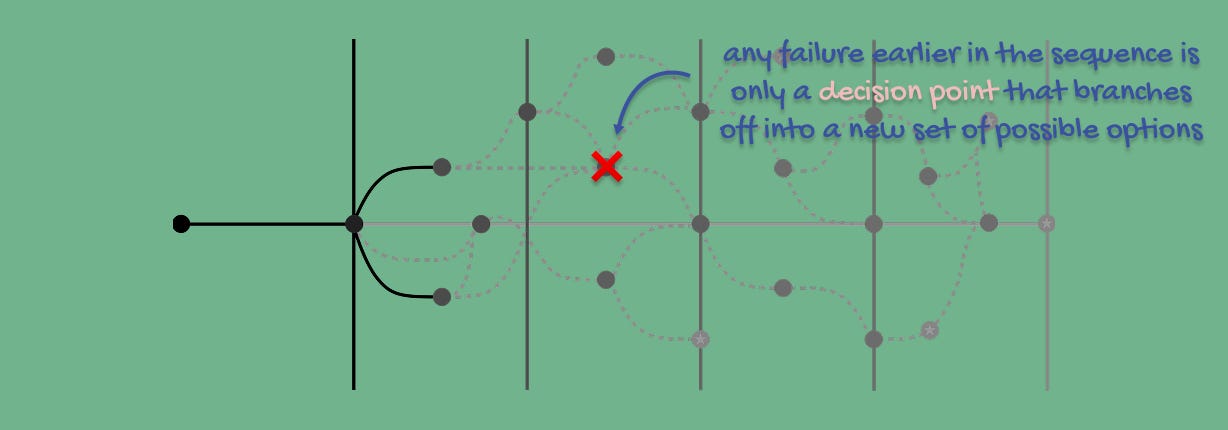
What is needed is a more adaptable, yet coherent representation of the overall topology that allows for multitudinal movement as opposed to cardinal control or ordinal orthodoxy. This requires a reimagined perspective on interleaving patterns of uninterrupted flow and branching pathways of serendipitous opportunity; both of which debunk the myth of linearly progressing loops.
Make no mistake, this is a practical first step in opening our minds to the mix of variables within the system, but by no means is it an easy one. On the contrary, we have to accept that the only way to truly succeed in this platform-driven environment is to match our approaches and operating models to the inherent complexity within the platform networks that we wish to grow and scale. There are no shortcuts. There is no faking it.
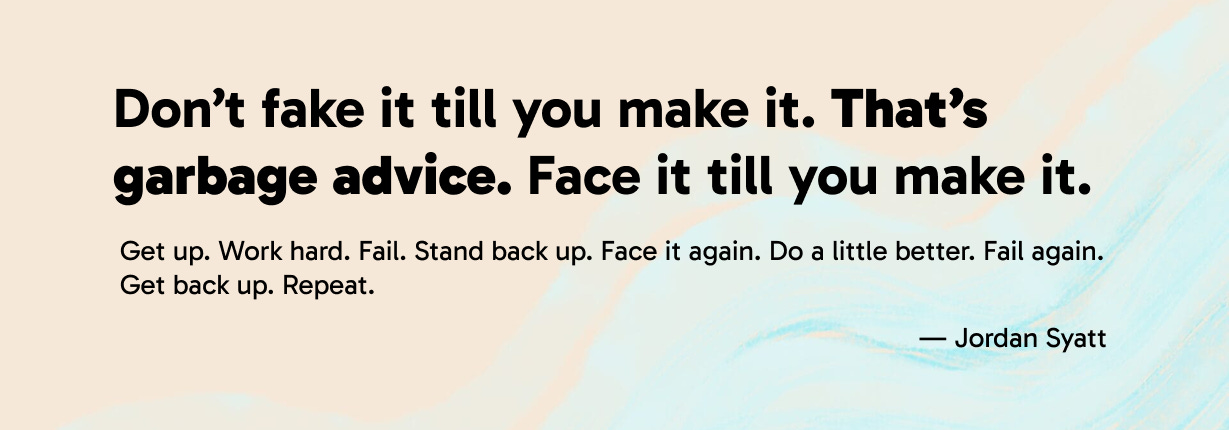
If you chose to do, then through the course of plotting the various decision points and paths for the organization, a breakthrough happens that materializes a multitude of options at your disposal. Instead of the rigid plans that can reduce a company to nothing more than a one-trick pony, you are now
More adaptive to unintentional edge cases since options allow for on-the-fly adjustments
More quick to act on imperfect information with several options providing built-in contingencies
More likely to spot macro signals impacting multiple options rather than a particular statistic
More fearless to experiment with indirect approaches that eventually converge into a desired impact
This view on non-linearity offers several advantages. The first is that it is much more in-line with the essence of the lean and agile movements, specifically of kaizen and flow. Second is that it mirrors the responsibilities of product managers by providing some basis of structured decision making. Third, while innovation and creativity with platforms is found, not forced, having options allows the system to provide flexible incentives and fosters invitation instead of coercive demands and commanding tasks. Despite stressing that platforms are not manufactured, we are able to engineer serendipity in part by encouraging collective creation and improvisation to happen in places we least expect.
Think in terms of decision points, not end states. Create options, not obligations.